



When it comes to managing piles (Arsha) in India, two names dominate the pharmacy shelves: Patanjali Arshkalp Vati and Himalaya Pilex. From a BAMS (Bachelor of Ayurvedic Medicine and Surgery) perspective, both formulations are rooted in ancient wisdom, but they operate quite differently on the human physiology.
If you are confused about which bottle to pick up, let’s break down the science, the ingredients, and the clinical reality behind these two Ayurvedic giants.
1. Patanjali Arshkalp Vati: The Cooling Warrior
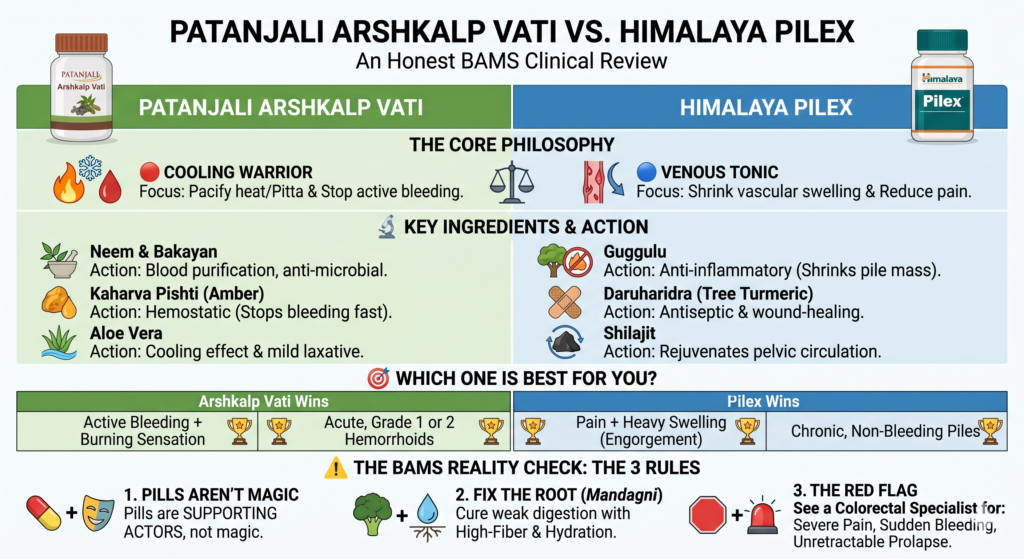
Patanjali’s formulation is often viewed as a “symptom-focused” remedy. Its primary goal is to pacify the Pitta (heat) and Vata imbalances that lead to painful, bleeding piles.
Key Ingredients & Action:
-
Nimba (Neem) & Bakayan: These act as powerful blood purifiers and anti-microbials, helping to shrink the pile mass.
-
Kaharva Pishti: A traditional Ayurvedic preparation of Amber, it is highly effective at stopping active bleeding due to its Stambhana (hemostatic) properties.
-
Ghrit Kumari (Aloe Vera): Provides a cooling effect and mild laxative action.
The Professional Verdict: Arshkalp Vati is excellent for Grade 1 and Grade 2 bleeding piles where inflammation and burning are the primary complaints.
2. Himalaya Pilex: The Venous Tonic
Himalaya takes a more “vascular-centric” approach. Pilex is designed to strengthen the veins and reduce the “engorgement” (swelling) of the rectal area. It is widely recognized for its consistency and research-backed results.
Key Ingredients & Action:
-
Guggulu (Balsamodendron mukul): A legendary anti-inflammatory that helps reduce the size of the hemorrhoidal mass and eases pain.
-
Daruharidra (Tree Turmeric): Known for its wound-healing and antiseptic properties, helping to heal internal tears or fissures.
-
Shilajit: Acts as a rejuvenator and helps in maintaining healthy pelvic circulation.
The Professional Verdict: Pilex is often more effective for chronic, non-bleeding piles and as a long-term tonic to prevent recurrence by improving venous health.
Head-to-Head Comparison
| Feature | Patanjali Arshkalp Vati | Himalaya Pilex |
| Primary Focus | Stopping bleeding & cooling | Reducing swelling & pain |
| Best For | Acute bleeding piles | Chronic engorged piles |
| Laxative Effect | Moderate | Mild |
| Form Factor | Tablets only | Tablet & Ointment combo |
| Price Point | Very Budget-friendly | Mid-range |
The BAMS Reality Check: Don’t Forget the “Root”
In Ayurveda, Arsha (Piles) is often called “Mandagni”—a result of weak digestive fire. While these tablets are helpful, they are not magic bullets. If you continue to eat junk food or sit for 10 hours a day (the classic Bangalore techie/commuter lifestyle), no amount of Arshkalp or Pilex will provide a permanent cure.
When to Choose Which?
-
Choose Arshkalp Vati if your main symptom is bleeding and burning. It acts faster on the Pitta-aggravation.
-
Choose Himalaya Pilex if your main symptom is swelling, discomfort, and pain without significant bleeding. It works better on the “mass” itself.
Critical Safety Warning
As a clinical rule, Self-medication has limits.
-
Pregnancy: Never take these without consulting your OB-GYN or Ayurvedic doctor, as many ingredients can stimulate pelvic blood flow.
-
Chronic Constipation: If you don’t fix your stool consistency with a high-fiber diet, these tablets will only provide temporary relief.
-
The Red Flag: If you notice a sudden increase in blood, weight loss, or severe pain that prevents sitting, stop the pills and see a colorectal specialist immediately. It could be a Grade 4 prolapse or a complex fistula that requires more than just herbal intervention.
Final Thought
Both Patanjali and Himalaya offer quality support. However, for a truly “Piles-free” life, treat these as supporting actors, while diet, hydration, and movement play the lead roles in your recovery.